
I’ll be interviewing Women’s Prize longlisted author Jesmyn Ward at the beautiful Central Library, Manchester on 27th April, 2018 as part of the Manchester Literature Festival. More details here. Join us!


I’ll be interviewing Women’s Prize longlisted author Jesmyn Ward at the beautiful Central Library, Manchester on 27th April, 2018 as part of the Manchester Literature Festival. More details here. Join us!

Published in the i paper, 13th October
The Mother of All Questions: Further Feminisms
By Rebecca Solnit
Granta, £12.99
Review by Anita Sethi
Silence and violence are the topics terrifically tackled by Rebecca Solnit in her excellent new essay collection which she describes as completing a trilogy together with Men Explain Things to Me (2014) and Hope in the Dark (2004), the former which popularised use of the term ‘mansplaining’ and the latter a powerful political manifesto which saw a surge in sales following the election of Donald Trump. Interspersed are 6 striking drawings of ‘hairscapes’ by Paz de la Calzada which work well plaited together with Solnit’s signature style and themes, in itself an intricate weaving.
“We talk about open questions, but there are closed questions, too, questions to which there is only one right answer, at least as far as the interrogator is concerned”, writes Solnit who subtly explores silences implicit even within speech. In the title essay, ‘The Mother of All Questions’, Solnit recounts the frustrating experience she had in which a male interviewer hounded her with the question of why she didn’t have children (he “insisted that instead of talking about the products of my mind, we should talk about the fruits of my loins, or the lack thereof”). At their heart, such questions are not questions but assertions and assumptions, argues Solnit, that women must marry and breed, and that there is only one way for a woman to live her life. “Would you ask a man that?”, is the question she now uses to stymie such questions.
In the book’s first part, Silence is Broken, Solnit gives ‘A Short History of Silence’, a fascinating look at the many ways in which silence has been used to oppress women and maintain the patriarchy. “What I regretted most were my silences…And there are so many silences to be broken”, wrote Audre Lorde, the section’s epigraph. Having a voice is central to human rights, explains Solnit, “and so you can consider the history of women’s rights and lack of rights as a history of silence and breaking silence”. Solnit ranges widely through history, from Virginia Woolf (“I want to write a novel about silence. The things people don’t say”, wrote Woolf) to the contemporary use of social media hashtags in which women have shared experiences of silencing, and through which they have broken that silence.
The book is filled not only with the closed questions Solnit has been asked but the cogent ones she asks. Who has been unheard and why have they been unheard?, she probes, and recounts how the struggle for liberation has been in part to create the conditions for the formerly silenced to speak and be heard, the intersection of the civil rights movement and feminism, how genocide and slavery are forms of silencing. She also considers how patriarchy requires that men silence themselves first, including aspects of their emotional lives.
Solnit perceptively explores the connection between silence and violence, since “violence against women is often against our voices and our stories… It is a refusal of our voices”. She gets to the core of what a voice means (“the right to self-determination, to participation, to consent or dissent, to live and participate, to interpret and narrate”). She unflinchingly details cases of abuse, murder and rape, and also traces how attitudes have evolved thanks to those who have bravely broken the silence and challenged their perpetrators.
The book’s second part, ‘Breaking the Story’ explores the ways in which stories and language can harm or heal, make us or break us, and how discrimination occurs both societally and linguistically. Solnit both exposes and dismantles the narratives that have propped up patriarchy. The essay ‘80 Books No Woman Should Read’, for example, is a pithy response to Esquire’s list ‘The 80 Best Books Every Man Should Read’ which included only one female author.
Exploring the ways we dehumanise one another, the book is also infused with hope for a more humane world. Here is an eloquent clarion call for empathy.


INTERVIEW WITH ROBERT MACFARLANE

 I’ll be in conversation with Anne Michaels at the Manchester Literature Festival on Tuesday 10th October, 2017.



I’m Journalist in Residence at the Durham Book Festival from 12th – 15th October where I’ll be chairing events with Harriet Harman, Lionel Shriver and Alexei Sayle, June Sarpong, Chibundu Onuzo and Sarah Winman. Come along to some of the events!

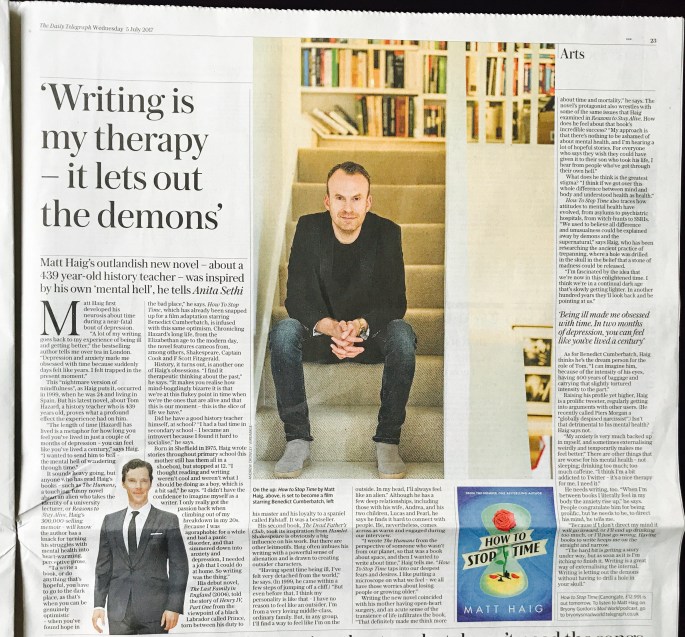
Click here to read my interview with Matt Haig (published 5th July, Telegraph), about time, writing, depression and his excellent new novel, How to Stop Time.
Feature on Arundhati Roy. From the i paper
“What makes you happiest – writing fiction or non-fiction?”, I ask Arundhati Roy who is on a flying visit to the UK where she has just given an exclusive reading from her forthcoming new novel The Ministry of Utmost Happiness, at a showcase in Soho hosted by her publisher, Penguin. There is no hesitation, no gap of twenty seconds let alone twenty years – the time it has been between publication of her 1997 Booker Prize-winning debut novel The God of Small Things and her new one – before she responds with a smile and, holding aloft a proof copy of her new novel so that the golden words of the title glint in the light, replies: “Fiction”.
The thread of happiness and unhappiness is woven not only through the new novel but throughout the course of Roy’s life. In the past twenty years Roy has been a prolific political writer and activist speaking out against injustices of poverty, inequality, nuclear weapons – but has been imprisoned for her words, found guilty in India of ‘contempt of court’.
Born in Shillong, India in 1961, Roy spoke movingly about her childhood on Desert Island Discs earlier this year – how her mother, a women’s rights activist, divorced her father, an alcoholic, but had nowhere to go so they lived for a time in her grandmother’s house (“Everybody used to tell us – why don’t you get out? This is not your house. You have no right to be here. And so I’d spend all my time on the river…I grew up wild”). Roy left home aged 17 and studied architecture before becoming a writer. Her debut novel catapulted her into the literary spotlight when it won the Booker Prize and went on to sell 6 million copies and be published in 40 languages.
Roy’s publisher, Simon Prosser, comments: “Like, I feel sure, most readers, I can still remember exactly where I first read it and how I felt while reading it”. I vividly remember where I was when I first read The God of Small Things and how I felt while reading it – I was a teenager, curled up in my bedroom in Manchester, dreaming of one day making a living from words and becoming a writer. That felt, though, like an impossible dream. I loved reading and devoured books from the local library but rarely saw myself represented in them – there were barely any brown people in the books I read. The Booker Prize had been won by VS Naipaul, Salman Rushdie, Kazuo Ishiguro and Ben Okri but Roy was the first woman of colour to be awarded the prize at a time when it still felt that books were overwhelmingly the preserve of the ‘great white man of literature’. Through the novel I was transported from my bedroom in Manchester to the riverbanks of Kerala. I knew my ancestors were from India but had not yet been. I experienced the power of literature to transport the reader and perhaps, I thought, I should not give up my writing dream after all.
When I hear Roy read from the new novel at the Showcase, the evocative writing again transports me. After the reading, Roy reflects on how “India is a place of so much diversity in so many religions, ethnicities, and so many languages – that’s how we live, in this cauldron of language. It is interesting writing from a space where there is not any one language. There isn’t any authentic language in which this book could have been written.” She continues: “Those are big chauvinistic debates in countries like India now – what is authentic? Who is really Indian? Who is not? Who should be massacred and who should not?”.
Roy’s editor Simon Prosser, who has published much of Roy’s non-fiction and also edits Zadie Smith, Hari Kunzru and Robert Macfarlane, quizzes Roy after her reading, suggesting that the last twenty years of political essays, speeches, reportage have fed valuably into the novel. “Absolutely”, replies Roy. “With the political essays, they get me into so much trouble that each time I write one I swear to myself that I will never write another one…It’s five collections of essays that I never meant to write! But yes all of that understanding surely went towards writing this”.
Roy reflects: “I think this book could not have been written any quicker or slower than it was. It’s also true that some stories are much greater than an accumulation of facts and can only be told in fiction”. On topic of fiction versus non-fiction, she points out: “As a political writer and an essayist I’m pretty straightforward about what I want to say but I’m the opposite when I write a novel – it’s not a manifesto, it’s not trying to give information or get people to think in a different way, it really is trying to understand the air, and trying to understand the heart”.
Roy speaks about her influential friendship with the late John Berger, who was instrumental in inspiring her to finish the novel: “John Berger is someone I loved and admired. Many years ago, in 2009 I think, I’d already been writing this book for ten years – not in some desperate way but it takes its own time – I was with him in his village and after dinner he said: ‘OK, open your computer and read me what you’ve been writing’. He’s the only person in the world who could have made me do that. And I did. There are parts of this book which have been unchanged for years – the opening paragraph is still the opening paragraph. And he said: ‘I want you to go back and I just want you to finish it. Don’t write anything else, just this’. And I promised him I would. He used to call me Utmost as he knew the title.” What did you call him?, asks Prosser. “I used to call him Jumbo – once I was upset about something and he said, ‘just imagine I am standing behind you like an old elephant or something, flapping my ears to cool you down’, and I said, ‘thanks, Jumbo’”.
Roy returned to India determined to do nothing else but finish the novel – but was scuppered by a note slipped under her door. “The note was from the guerrillas in the forests in central India fighting against the big mining companies inviting me to go into the forest and spend some weeks with them, and they wouldn’t trust anyone else. I couldn’t say no – so I went”. After coming out of the forest she wrote a powerful essay called Walking with the Comrades (“which of course got me into trouble”).
On finally finishing the novel: “the first thing I did in September was to go to Paris with the manuscript and I gave it to John [Berger] and I think it was the last book he read before he went into the other room and I’m so grateful for that”.
She is eager for the book to hit the bookstores before it can be banned or censored in India and recounts the ordeals she has been through, such as being “charged with sedition”. She continues: “I do want to say that I’m pretty worried about the situation in India right now”. She recalls the hostility she has faced: “If I’m supposed to speak somewhere these gangs of storm troopers gather, saying ‘Arundhati Roy is a traitor!’ And stupid stuff.”. She describes the situation as being “like trip-wires”, the sense of “constant harassment”, and how “they stone and smash the stage when you speak, they threaten you…it just goes on and on and on”.
Roy speaks of the need to stand firm in the face of false assumptions and to create a psychological space for writing fiction where such negative voices are absent: “I eventually realised that if I was allowing that voice in my head I would not have written anything. So I told myself, OK write it the way you want to write it – exorcise that voice from your body and then keep the manuscript in a draw. Because you just go mad if you don’t write it. But of course once it’s done the writer’s ego does not allow it to be kept in the draw.” The book is embargoed until 28th May but I can reveal that, having had an exclusive preview read, it’s of utmost happiness that it did not stay in Arundhati Roy’s draw – here is a book that needs to be in the world.
The Ministry of Utmost Happiness is published by Hamish Hamilton on 6th June


My book review of PUSSY by Howard Jacobson, published in the i paper on Friday 14th April. Click here to read it.
 Anita Sethi